Three visits to the thatched cottage
The Romance of the Three KingdomsThree visits to the thatched cottage marks the transition from Xuande’s search for counsel to his partnership with Kong Ming. Across repeated journeys to the secluded hut, Xuande demonstrates that he will approach the strategist on his own terms rather than summon him by rank. Their eventual meeting yields a plan for the divided empire; Xuande’s concern for the people, expressed as he asks Kong Ming to teach and serve, finally draws the recluse into public life.
A search shaped by absence
Xuande turns to the search after the loss of Shan Fu as an adviser. Remembering Shan Fu’s recommendation, he sets out with his two sworn brothers to find Kong Ming, known as the Sleeping Dragon. Their first journey takes them to a rural hut in a valley whose modest hills, clear streams, and simple woodland Xuande regards as a scene of perfect peace. The young man at the door cannot remember Xuande’s long list of formal titles, and Kong Ming is away. Xuande leaves disappointed, but turns back to look at the quiet landscape once more before riding off.
The first failure does not end the search. A few days later, word arrives that Kong Ming has returned, and Xuande sets out again despite Zhang Fei’s objection that he should simply order the sought-after man to come to him. The weather worsens on the journey; snow begins before dusk, and Zhang Fei urges a return to the warmth of the city. Xuande nevertheless continues. At the hut he learns that the reader inside is not Kong Ming but the youngest brother, Zhuge Jun; the family connection supplies information, not the meeting Xuande has come for.
The third approach
When news later comes that Kong Ming has returned, Xuande makes a third journey with his brothers. Zhang Fei again objects, this time to the effort of travelling in bitter cold to see a man he considers unworthy of such trouble. Xuande silences him. Their persistence reflects Xuande’s conviction that a celebrated sage should be approached with respect, rather than treated as a subordinate who can be ordered to attend.
At last, Kong Ming is present, but asleep. Xuande enters and waits deferentially at the foot of the bed while the hours pass. Zhang Fei’s impatience grows until he threatens to set fire to the rear of the hut to wake the sleeper; Xuande restrains him. The scene makes the difference between the two brothers plain: Zhang Fei measures the encounter by urgency and obedience, while Xuande accepts the discomfort and delay as part of winning Kong Ming’s trust.
When Kong Ming wakes, he asks his assistant whether visitors have come. On hearing that Xuande, the emperor’s uncle, has waited for a long time, he is annoyed that no one woke him and goes to change into appropriate clothes. His appearance, in a long cloak of crane feathers and a silk-bound headscarf, reinforces the impression of a gentleman set apart from ordinary political life. Xuande greets him humbly, identifies himself as one of the remaining members of the House of Han, and explains that he has already tried twice to meet him.
Counsel for a divided realm
Kong Ming initially minimizes his own standing, describing himself as an ordinary farmer rather than a suitable guide for a ruler. Xuande refuses that dismissal. He says that he does not want to spend his life hidden away while the land needs his wisdom, and asks him to teach. Xuande describes the Han as collapsing under the power of corrupt ministers; though he considers himself weak, he wants the realm governed justly and believes Kong Ming can help him achieve that end.
Kong Ming answers by interpreting the political landscape. He traces the disorder to Dong Zhuo’s rebellion, then identifies Cao Cao in the north as a rival too powerful for Xuande to confront directly: Cao Cao has overcome the stronger Yuan Shao by cunning, commands a vast army, and controls the emperor, gaining the allegiance of many nobles. Sun Quan, by contrast, governs south of the river with the support of the people and should be treated as a potential ally rather than an enemy. Kong Ming directs Xuande’s attention to Jingzhou, ruled by Liu Biao, as the place where the future will be decided and the base from which Xuande should build his position.
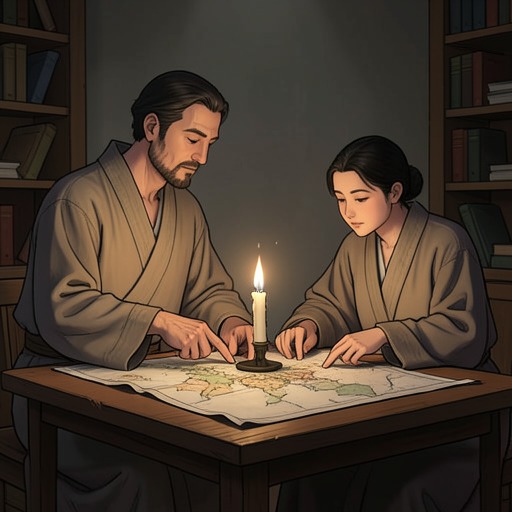
Using a map, Kong Ming explains the alliances and territorial steps needed to extend Xuande’s power, and predicts that the plan will make him a hero to ordinary people. Xuande raises an ethical obstacle: Liu Biao and Liu Zhang are both members of the imperial family, so attacking or usurping them would violate kinship. Kong Ming replies that Liu Biao is near the end of his life and that Liu Zhang lacks ambition and may be willing to serve under Xuande. The advice thus joins political calculation to claims about family, legitimacy, and the Will of Heaven.
From audience to alliance
Even after giving his counsel, Kong Ming refuses Xuande’s request to join him, saying that he prefers rural solitude. Xuande’s answer is not a further argument about rank or territory. He weeps and asks what will become of the people. Confronted by the sincerity of that appeal, Kong Ming relents and agrees to serve. The third visit therefore produces more than a meeting: it turns a strategic conversation into a commitment, secured not by command but by Xuande’s stated concern for the population.
Kong Ming’s first practical warning follows immediately. Cao Cao is training his men in naval warfare, so he is likely preparing an invasion of the south by river. The prediction shows the new adviser already applying the larger political plan to an immediate military danger. Later, at Bowang, he directs the defense against Cao Cao’s advancing army: Guan Yu is to wait in the hills and strike the rearguard and supply train when flames appear; Zhang Fei is to attack the army stores at Bowang; other commanders prepare fires beside the ravine; and Zhao Zilong is ordered to lead the advance party and feign retreat. Xuande’s sworn brothers doubt the plan and resent Kong Ming’s distance from the fighting, but Xuande rebukes them and follows his adviser’s orders. The cottage encounter thus establishes the authority that his later military commands will test.
Political and narrative significance
The meeting answers a question raised by the larger account of the Three Kingdoms: how Xuande, one of three leaders who emerge as Han China fragments, can build a position against the stronger northern power. Kong Ming’s analysis distinguishes opponents from potential allies and identifies a territorial base, while Xuande’s response supplies the personal and ethical terms of their partnership. Their alliance grows from the contrast between a map of power and a plea for the people who live within it.
The repeated visits also make patience part of the event’s meaning. Xuande returns after disappointment, accepts the winter journey, waits while Kong Ming sleeps, and restrains Zhang Fei rather than forcing the encounter. The episode brings together two forms of legitimacy: Kong Ming’s strategic wisdom and Xuande’s claim to rule justly as a member of the House of Han. The resulting partnership directs Xuande’s fortunes and gives the political struggle a plan extending beyond survival in the immediate crisis.